
StitchedHealth
AI-Powered Medical Education & Continuing Learning Platform
What is StitchedHealth?
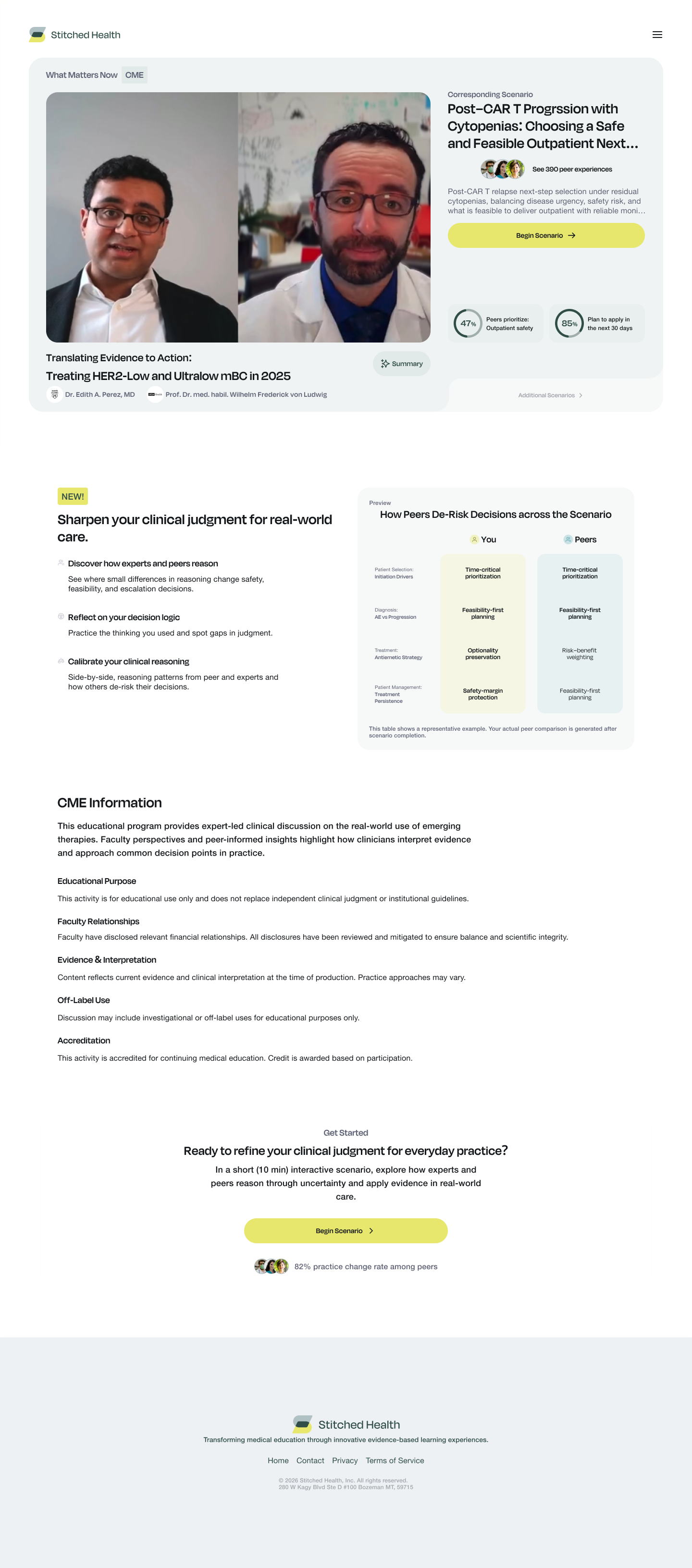
StitchedHealth is a medical education platform that transforms how clinicians engage with continuing education. Through interactive case studies built around real patient scenarios, clinicians progress through diagnostic decision trees, share peer perspectives, receive AI-generated feedback, and earn accredited continuing education credits. The platform addresses a persistent gap in medical education: traditional CME programs are passive, one-directional, and disconnected from clinical reality. StitchedHealth makes learning active and social — clinicians see how peers approach the same case, receive structured AI analysis of response patterns, and gain evidence-backed insights from integrated RCT literature.
Medical education needs a feedback loop
Continuing medical education has remained structurally unchanged for decades. Clinicians attend lectures, read articles, and check boxes — but the learning rarely connects to how they actually make clinical decisions. Existing platforms deliver content passively with no mechanism to surface how peers are reasoning through the same cases.
Peer Learning at Scale
Clinicians learn best from each other, but there was no structured way to aggregate, score, and present peer perspectives on clinical decisions. Free-text responses needed AI-powered quality scoring and thematic grouping to surface meaningful patterns.
Evidence Integration
Case studies needed to be enriched with real RCT evidence — not just referenced, but analysed and summarised by AI so clinicians could see how their decisions align with empirical data.
Content Intelligence
Admins needed to understand engagement patterns, response quality, and learning outcomes at scale. Every interaction had to be tracked, analysed, and surfaced through comprehensive analytics.
StitchedHealth’s backend is composed of two purpose-built services that work in concert. The separation was a deliberate architectural decision: the AI workload (LLM-intensive, variable latency) is fundamentally different from the API workload (low-latency, high-concurrency), and keeping them decoupled allowed each to scale independently.
Service 1 — NestJS Application Server
The primary backend handles all product logic: authentication (JWT + Google SSO), user management across three roles (Super Admin, Admin, Clinician), educational program and case study CRUD, response tracking through a five-level hierarchy, peer perspective management with AI scoring, analytics, and credit tracking. It exposes a REST API backed by PostgreSQL via Prisma ORM, with Redis for multi-tier caching and BullMQ for async job orchestration.
Service 2 — Python AI Microservice (FastAPI)
A standalone FastAPI service responsible for all AI and LLM workloads. It receives requests from the main backend, processes clinical content through LangChain pipelines with GPT-4o and Claude, and returns structured JSON results. Features include peer perspective tag creation, RCT summary generation, comment ranking, hierarchical summaries, NPI verification, and content extraction from uploaded files.
End-to-End Flow
Layered Architecture
Where the hard problems lived
AI-Powered Peer Perspective Pipeline
Clinicians submit free-text responses to clinical questions, and these responses need to be scored, tagged, grouped, and summarised automatically. A multi-stage AI pipeline was built: GPT-4o-mini creates thematic tags for each response, a separate LLM ranks responses against RCT evidence on a 1–4 scale, and a summarisation layer groups related perspectives into peer clusters. All of this feeds into a hierarchical summary system that rolls up from question-level through section-level to full case-study summaries.
Five-Level Response Tracking Hierarchy
Every clinician interaction is tracked through a deeply nested hierarchy: EP Response → Case Study Response → Section Response → Question Response → Option Selection. This enables granular progress tracking, credit calculation, and analytics. The challenge was maintaining data integrity across this five-level chain while supporting question branching logic (FlowRules) that dynamically changes the path based on answers.
RCT Evidence Integration
The platform ingests Randomized Controlled Trial PDFs, extracts text, and generates structured clinical summaries using LLM pipelines. Individual RCT summaries are then compiled into aggregate summaries. These evidence bases are used to evaluate MCQ options, rank peer comments, and provide evidence-aligned feedback — turning static research papers into dynamic decision-support tools.
Multi-Tier Caching with Cache Invalidation
A two-layer cache architecture was implemented: L1 in-memory (Keyv with CacheableMemory, 5000 items, 60s TTL) and L2 Redis (distributed, configurable TTL). Static content like educational programs and case studies are aggressively cached, while dynamic content like peer perspectives use short TTLs. Cache invalidation on content updates was the most delicate part — stale clinical content is not acceptable.
Dual-LLM Strategy: GPT-4o + Claude
The AI microservice uses both OpenAI and Anthropic models strategically. The Chips pipeline (content extraction, citations, label generation) uses Claude Sonnet for complex analysis and Claude Haiku for high-throughput tasks like open-text responses. The LangSmith-managed endpoints use GPT-4o for structured output via LangChain. Prompt caching with 5-minute TTL prevents LangSmith API rate limiting.
Technology decisions


What was delivered
Growth Loops Technology delivered StitchedHealth from initial architecture to a production-ready platform encompassing a modular NestJS backend with 20+ feature modules, a full PostgreSQL schema with 40+ tables and complex entity hierarchies, a Python AI microservice with 11+ LLM-powered endpoints, and a comprehensive analytics and engagement tracking system. The most technically demanding aspect was building the AI-powered peer perspective pipeline: scoring free-text clinical responses against RCT evidence, generating thematic tags, clustering perspectives, and rolling everything into hierarchical summaries that clinicians could consume in seconds.
Key Engineering Takeaways
Decouple AI microservices from API servers early — LLM latency is unpredictable and should never block user-facing endpoints
LangSmith prompt management with caching is essential for production LLM systems — prompt versioning and observability prevent silent regressions
Multi-tier caching (memory + Redis) dramatically improves response times for content-heavy platforms, but cache invalidation for clinical content must be bulletproof
BullMQ with Redis is excellent for complex job pipelines, but job idempotency and status tracking must be built explicitly from day one
Structured output from LLMs (Pydantic models via LangChain) is non-negotiable for production — free-form responses are too fragile to persist to a database