

Servana
AI-Powered Industrial Support Platform for Reducing Equipment Downtime
What is Servana?
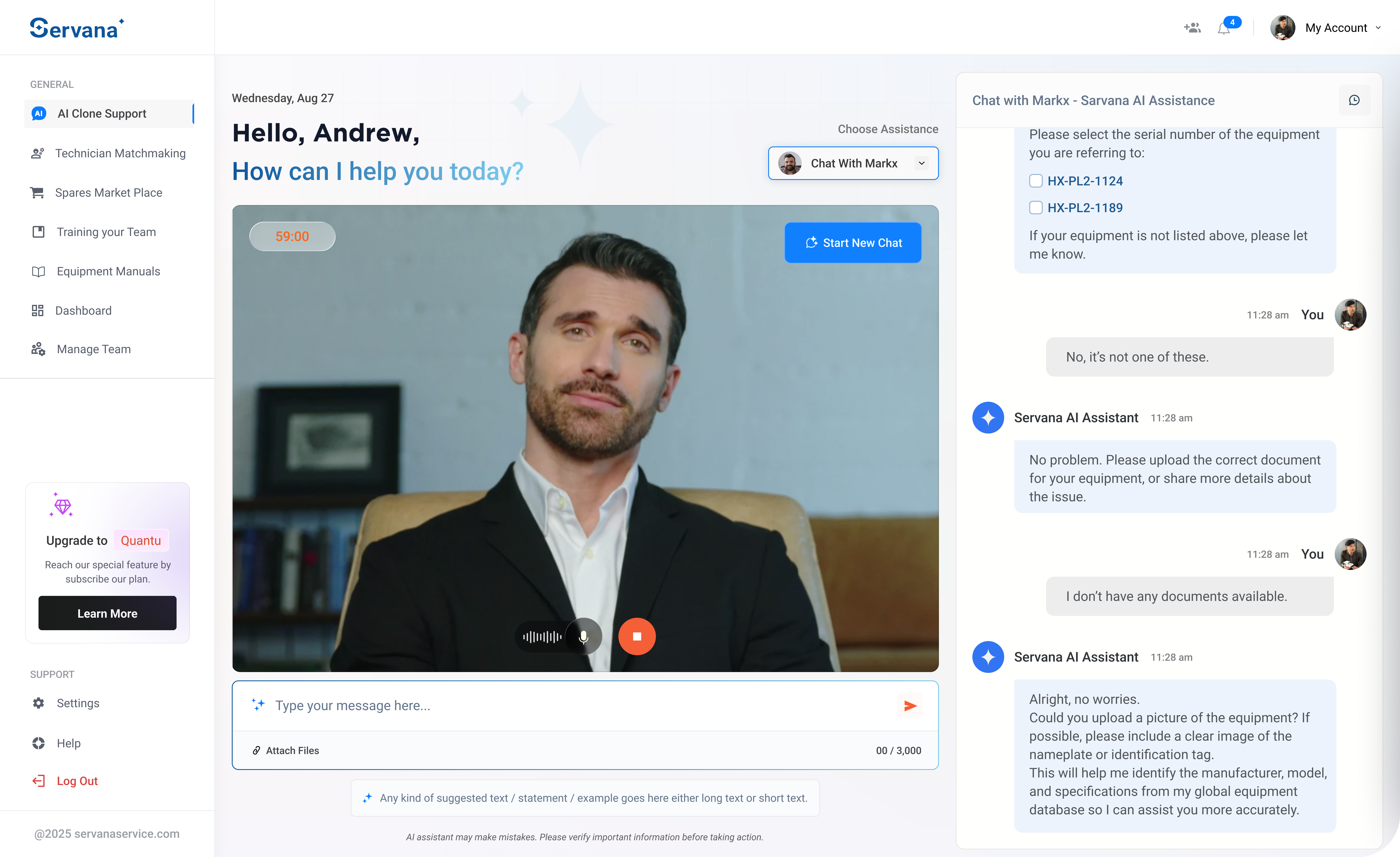
Servana is an AI-powered industrial support platform designed to reduce equipment downtime and improve operational efficiency. The platform provides a unified digital ecosystem where operators can raise incidents using text, voice, or images, AI analyses and classifies issues, knowledge is retrieved from manuals and historical data, and issues are resolved via AI guidance or technician escalation. All interactions continuously improve system intelligence. This case study outlines the business problem, solution approach, execution strategy, and outcomes delivered during the MVP phase of the Servana platform.
Servana operates in asset-heavy industrial environments where equipment failures directly impact productivity and cost. The platform targets ecosystems involving operators, technicians, spare-part sellers, and administrators who currently rely on fragmented and manual support processes.
Industrial support is broken by fragmentation
Industrial operators face repeated challenges that lead to increased operational costs and inconsistent service quality. Equipment failures trigger cascading delays across the entire operation, and the existing support infrastructure relies on manual processes, disconnected communication, and siloed knowledge that make fast resolution nearly impossible.
High Equipment Downtime
Equipment failures cause significant downtime with no automated system to diagnose issues or suggest fixes. Operators are left waiting while manual troubleshooting processes slowly identify the problem, directly impacting productivity and revenue.
Delayed Technician Access
Finding and dispatching qualified technicians is a manual, time-consuming process. There is no centralized system for matching operator needs with technician availability and expertise, leading to prolonged resolution times.
No Centralized Knowledge
Equipment manuals, historical repair data, and troubleshooting guides are scattered across physical documents and disconnected systems. Technicians and operators cannot quickly access the knowledge they need to resolve issues efficiently.
Manual Troubleshooting & Communication
Issue reporting, diagnosis, and coordination between operators, technicians, and spare-part sellers happens through phone calls, emails, and paper forms. This fragmented communication leads to lost context, repeated explanations, and coordination failures.
Inefficient Multi-Role Coordination
Operators, technicians, sellers, and administrators each work in isolation with no shared platform. Coordinating across these roles for incident resolution, parts procurement, and service tracking requires significant manual overhead.
Servana follows a modular architecture designed to support AI-driven industrial operations at scale. The platform separates concerns across a web-based frontend for all roles, secure backend services, an AI orchestration layer, and a centralized vector-based knowledge store — all with role-based access enforcement across modules.
AI Query & Diagnostics Engine
The core intelligence layer that powers Servana's support capabilities. It handles query classification, enriches context from historical data, retrieves relevant information from vectorized equipment manuals and documents, generates responses using LLMs, and continuously learns from feedback loops to improve accuracy over time.
Multi-Role Application Platform
A unified web-based platform serving four distinct roles — Operators (AI clone support, incident management, technician matching), Technicians (profile management, job lifecycle, file uploads), Sellers/OEMs (product catalog, sales workflows), and Admins (user management, team oversight, role-based dashboards). Each role has a tailored interface backed by shared secure services.
Knowledge & Vector Store
A centralized knowledge repository that vectorizes equipment manuals, repair guides, and historical incident data using Pinecone. The store supports fast semantic retrieval for AI-powered diagnostics while maintaining strict data isolation through metadata-based access control, keeping global and private knowledge strictly separated.
End-to-End Flow
Layered Architecture
Where the hard problems lived
AI Accuracy Tuning During Early Iterations
The AI diagnostics system needed to provide accurate and useful responses from the very first iteration, but LLM-powered retrieval from vectorized equipment manuals required extensive tuning. Query classification, context enrichment, and response generation each needed calibration to ensure operators received actionable guidance rather than generic or irrelevant suggestions. Continuous feedback loops were built into the system to improve accuracy over time.
Multi-Role Workflow Coordination
Servana serves four distinct user roles (Operator, Technician, Seller, Admin) with deeply interconnected workflows. An operator raising an incident triggers technician matching, potential parts procurement from sellers, and admin oversight — all through a single platform. Building these cross-role workflows while keeping each module independently functional required careful API design and shared state management.
Strict Data Isolation in a Shared Knowledge Base
The vector-based knowledge store contains both global equipment knowledge and private organizational data. Ensuring strict data isolation so that one organization's proprietary repair data never surfaces in another's query results was critical. Metadata-based access control was implemented at the retrieval layer, adding complexity to every knowledge query but guaranteeing data security.
External Integration Dependencies
The full Servana vision includes payment processing and LMS (Learning Management System) integrations that were outside the MVP scope. Architecting the platform so these integrations could be added seamlessly in future sprints — without requiring core system refactoring — required forward-thinking API design and clean module boundaries from day one.
Technology decisions
What was delivered
Growth Loops Technology delivered the Servana MVP from initial architecture to a production-ready platform foundation. The delivery established a unified AI-powered ecosystem where operators can raise and resolve incidents through intelligent diagnostics, technicians manage structured workflows with full lifecycle tracking, sellers maintain product catalogs with integrated order flows, and administrators oversee the entire operation through role-based dashboards. The most technically significant outcome was the AI diagnostics engine: a retrieval-augmented system that classifies operator queries, retrieves relevant knowledge from vectorized equipment manuals, generates contextual responses using LLMs, and continuously improves through feedback loops — reducing dependency on manual troubleshooting and accelerating issue resolution across the platform.
Key Engineering Takeaways
AI-driven support significantly improves response times — automating query classification and knowledge retrieval reduces time-to-resolution from hours to minutes for common equipment issues
Knowledge centralization is critical for industrial operations — vectorizing equipment manuals and historical repair data into a single searchable store eliminates the knowledge silos that cause repeated failures
Metadata-based security is effective for multi-tenant AI systems — strict data isolation at the retrieval layer prevents knowledge leakage between organizations while sharing a common vector infrastructure
Early MVP focus helps validate core value before expansion — delivering a functional four-role platform with AI diagnostics proved the concept while keeping payment and LMS integrations cleanly scoped for future sprints